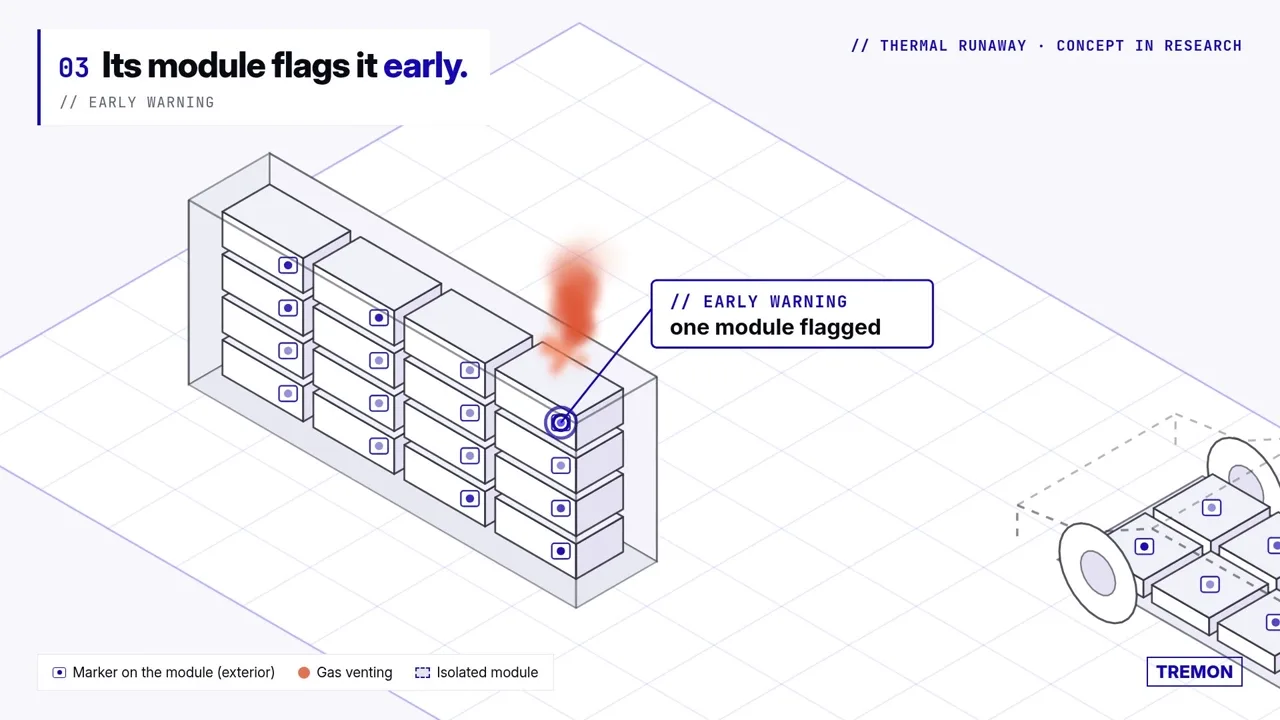
Thermal runaway rarely starts without a sign. Gas is one of the earliest — published numbers:
- 5–20 minutes: off-gassing precedes thermal runaway by roughly 5 to 20 minutes, according to FM.
- 7.8 minutes: in Sandia cell tests, FTIR saw the first gas signal 7.8 minutes before thermal runaway (2024).
- Electrolyte vapour first: at the first vent, DMC, EC and HF were among the first species detected; DMC alone made up 12–42 vol% of the vent gas (Lin & Ezekoye, 2025).
- Hydrogen often late: in installation tests, electrolyte (VOC) sensors triggered first, while common hydrogen and combustible-gas detectors often only confirmed that thermal runaway had started (Sandia, 2021).
- Early life matters: 72% of BESS failures with a known age happened during construction, commissioning or the first two years of operation (EPRI).
Codes and approvals are starting to name the precursor gas. Summaries are informational, not legal advice; codes change, so verify the current text before acting.
What we are trying to learn — not what we sell.
Our base is gas sensing R&D on our own NDIR products, plus research on photonic (PIC) gas sensing. For batteries we are screening three questions with people who run, design and insure battery systems:
- Where an early gas signal would change a decision — at rack, container or pack level, and who acts on it.
- Which gas is worth sensing for that decision, given that electrolyte vapour is the earliest selective marker in the published tests.
- Which optical technology fits. Optical electrolyte-vapour sensing already exists in mid-infrared NDIR form. Whether a chip-scale photonic sensor can do the same job is an open research question for us.
Is this a Tremon product?
Which gas comes first?
Can a photonic chip sense electrolyte vapour?
Let's research this together
We are screening where gas-based early warning could help battery systems isolate one module instead of the whole site or car. We want to learn this with the people who build, run, test and insure them.
- BESS owners, operators and integrators
- EV and e-mobility battery-pack engineers
- Battery test and certification labs
- Fire-safety engineers and insurers
- University and institute groups working on battery safety
- Expert interview — 30 minutes on how you handle battery off-gas and thermal runaway today, and where a new kind of sensor would — or would not — help.
- Feasibility study or pilot — We scope your use case together — your gas, site or system — and test whether the concept fits. A pilot follows once there is hardware to put on site.
- Joint research or grant consortium — Partner with us in a joint research project or an EU or national grant consortium on Li-ion off-gas and thermal-runaway early warning.
// research stage · not a product · [email protected]