Chemically inert and non-toxic at workplace limit (1000 ppm); 5× heavier than air, collects in trenches and cable basements and displaces oxygen. asphyxiant (inert); greenhouse gas GWP 24 300.
Sulfur fluoride [Note: May contain highly toxic sulfur pentafluoride as an impurity.]
Physical & chemical properties
Molar mass
146.05 g/mol
Boiling point (1 atm)
sublimes at -63.8 °C
Melting point
—
Critical temperature
45.6 °C
Critical pressure
37.53 bar
Vapour pressure
21 bar at 20 °C
Gas density
6.626 kg/m³ (0 °C, 1013 mbar)
Relative density (air = 1)
5.11
Solubility in water
31 mg/l at 25 °C
Appearance
gas liquefied under pressure, colourless, odourless
Odour
odourless
1 ppm at 20 °C
6.07 mg/m³
Behaviour with temperature and pressure
At atmospheric pressure SF₆ does not boil — it sublimes at -63.8 °C (solid ↔ gas); a liquid phase exists only above the triple-point pressure. Critical point 45.6 °C / 37.53 bar: below this temperature it can be stored as a liquid; cylinder pressure then equals the vapour pressure. Vapour pressure ≈ 21 bar at 20 °C — this is the pressure inside a cylinder or a switchgear compartment at that temperature, and it rises steeply with temperature (Clausius–Clapeyron). Relative density 5.11 (air = 1): heavier than air — accumulates in pits, cable basements and at floor level; place sensors low. Conversion at 20 °C, 1013 mbar: 1 ppm = 6.07 mg/m³; NDIR reads partial pressure, so readings scale with absolute pressure (value = reading × P/1013) and must be pressure-compensated.
// Non-combustible gas., Gas is heavier than air., Danger of suffocation at high concentrations due to oxygen displacement.
Hazards & safety
NFPA 704
health · flammability · instability · special
GHS / CLP pictograms
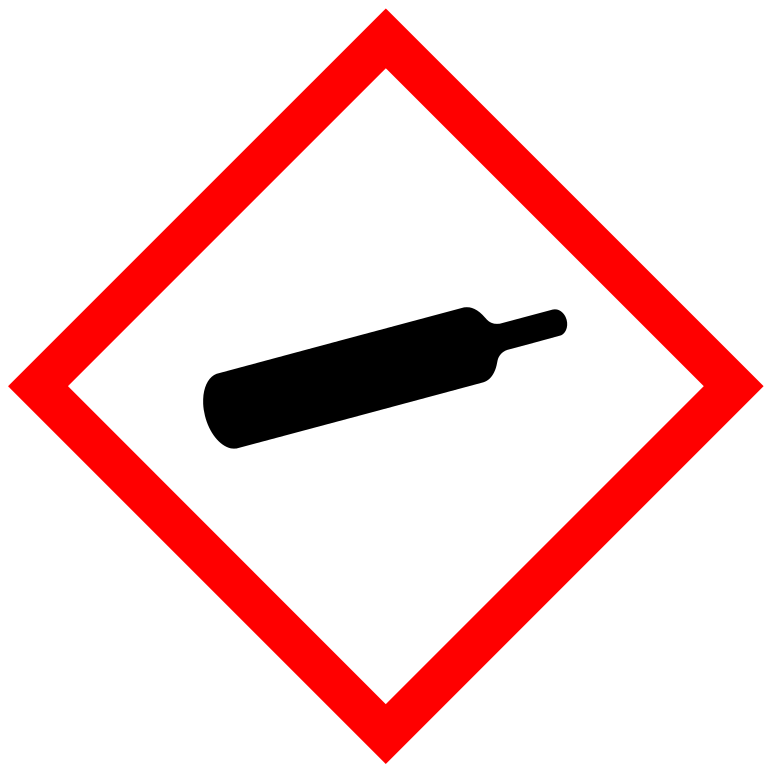
GHS04 · Gas under pressure
Hazard class
asphyxiant (inert); greenhouse gas GWP 24 300
GHS signal word
Warning
CLP classification
Gases under pressure, liquefied gas; H280
Hazard statements
H280: Contains gas under pressure; may explode if heated.
// Limits change: always confirm the current national value before setting an alarm. Values above were read from the EU directives / GESTIS / NIOSH pages listed in Sources.
Effect on people
Chemically inert and non-toxic at workplace limit (1000 ppm); 5× heavier than air, collects in trenches and cable basements and displaces oxygen. Arc-decomposition products (SOF₂, SO₂F₂, HF, S₂F₁₀) are highly toxic — the real hazard around faulted switchgear.
GESTIS main toxic effects: Acute:
Frostbite resulting from contact with the liquefied gas,
at very high concentrations suffocation due to displacement of oxygen from the air
Chronic:
No indications of any chronic toxic effects caused by the pure gas
Recommended monitoring
NDIR at 10.5 µm gives ppm-level room monitoring; density monitors (P/T compensated) on each gas compartment are the regulatory tool (Reg. 2024/573 Art. 5: monitoring device with automatic alert = exemption from periodic leak checks).
Alarms: 1000 ppm (OEL) in GIS rooms; leak-rate alarm from density trend; sampling at floor level.
Climate & atmosphere
GWP₁₀₀ — IPCC AR6
24300
GWP₁₀₀ — IPCC AR4
22800
GWP used in Reg. (EU) 2024/573
24300
Atmospheric lifetime
1000 years
Ozone depletion potential
0
Main IR absorption band (NDIR)
10.5–10.6 µm (ν₃ S–F stretch, 948 cm⁻¹) — very strong
Regulation windows
F-gas Regulation (EU) 2024/573 — switchgear phase-in bans 2026/2028/2030/2032 by voltage class; installed fleet exempt from leak checks only with density monitoring + automatic alert (Art. 5)
GWP 24 300 (Annex I) — every kg leaked = 24.3 t CO₂e