| Name | CFC-113 (Trichlorotrifluoroethane) |
| Formula | C₂Cl₃F₃ |
| IUPAC name | 1,1,2-trichloro-1,2,2-trifluoroethane |
| CAS number | 76-13-1 |
| EC number | 200-936-1 |
| UN number | 3082 — Environmentally hazardous substances, liquid, n.o.s. |
| Transport class (ADR/RID) | 9 (Miscellaneous items and materials) |
| PubChem CID | 6428 |
| Synonyms | CFC-113, Chlorofluorocarbon-113, Freon® 113, Genetron® 113, Halocarbon 113, Refrigerant 113 |
| Molar mass | 187.38 g/mol |
| Boiling point (1 atm) | 47 °C |
| Melting point | -35 °C |
| Critical temperature | 214.1 °C |
| Critical pressure | 33.8 bar |
| Vapour pressure | 0.36 bar at 20 °C |
| Gas density | 7.79 kg/m³ (20 °C, 1 bar (ideal gas, M/24.04; liquid at 20 °C)) |
| Relative density (air = 1) | 6.47 |
| Solubility in water | 0,17 g/l at 20 °C |
| Appearance | colourless, In low concentration odourless, in higher concentrations sweetish odour. |
| Odour | In low concentration odourless, in higher concentrations sweetish odour. |
| 1 ppm at 20 °C | 7.79 mg/m³ |
Boiling point 47 °C at 1 atm: a liquid at room temperature; vapour is the measured phase. Critical point 214.1 °C / 33.8 bar: below this temperature it can be stored as a liquid; cylinder pressure then equals the vapour pressure. Vapour pressure ≈ 0.36 bar at 20 °C — this is the pressure inside a cylinder or a switchgear compartment at that temperature, and it rises steeply with temperature (Clausius–Clapeyron). Relative density 6.47 (air = 1): heavier than air — accumulates in pits, cable basements and at floor level; place sensors low. Conversion at 20 °C, 1013 mbar: 1 ppm = 7.79 mg/m³; NDIR reads partial pressure, so readings scale with absolute pressure (value = reading × P/1013) and must be pressure-compensated.
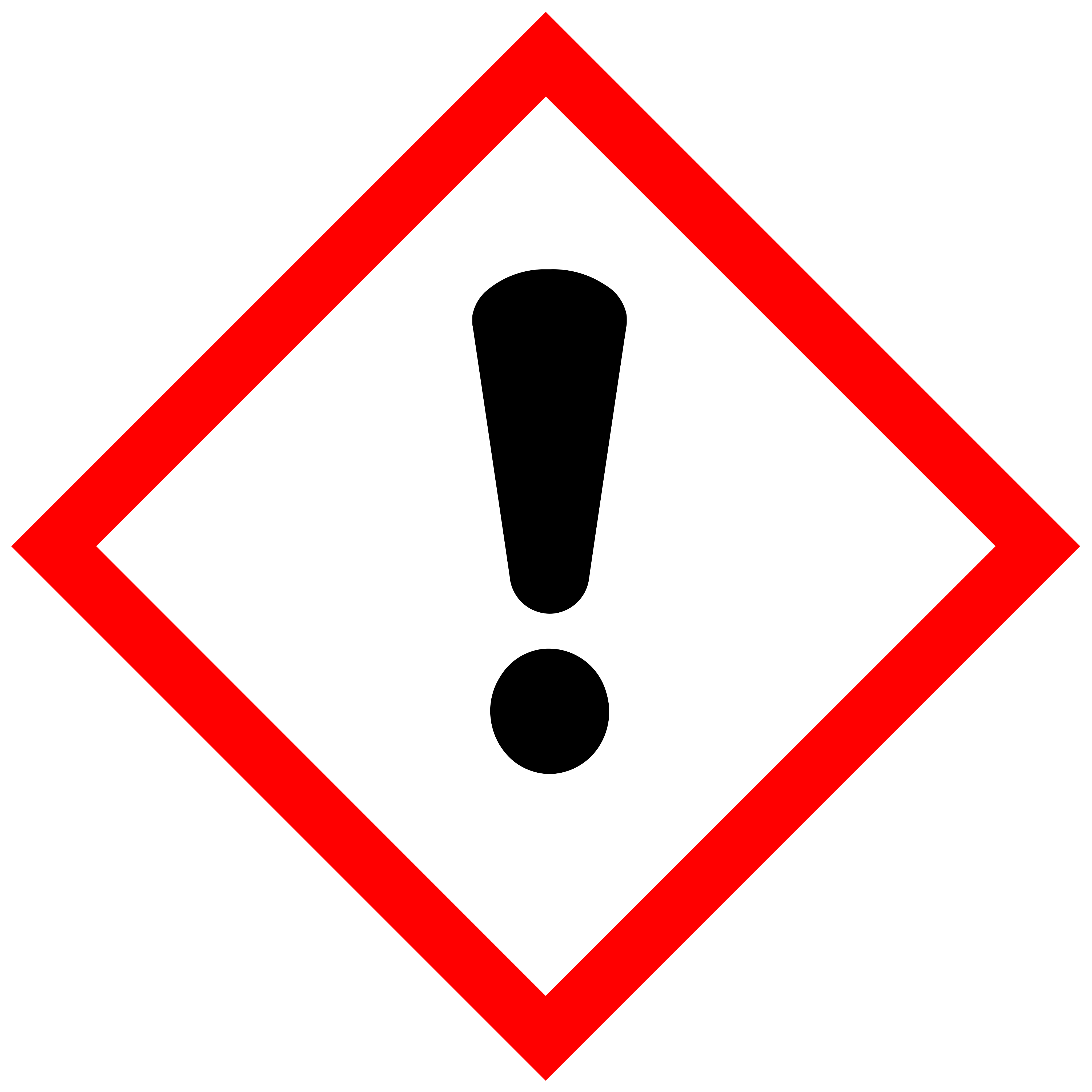
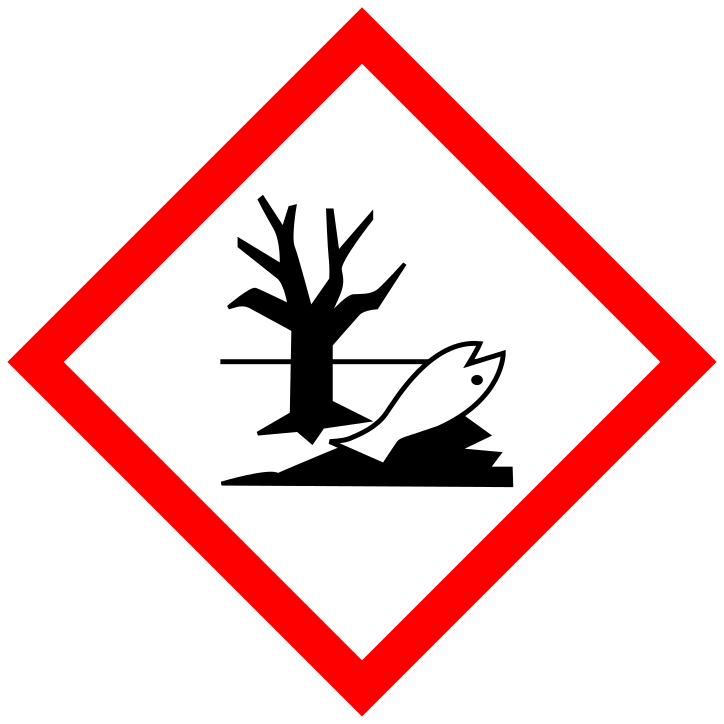
| Hazard class | asphyxiant; ozone-depleting + greenhouse gas (CFC) |
| GHS signal word | Warning |
| CLP classification | Eye irritation, Category 2; H319 Hazardous to the aquatic environment, Chronic Category 2; H411 Hazardous to the ozone layer, Category 1; H420 |
| Hazard statements | H319: Causes serious eye irritation. H411: Toxic to aquatic life with long lasting effects. H420: Harms public health and the environment by destroying ozone in the upperatmosphere |
| Lower / upper explosion limit | non-flammable |
| Auto-ignition temperature | 680 °C · T1 |
| Seveso III named substance | yes |
| EU indicative OELV (8 h TWA) | no EU IOELV |
| EU IOELV short-term (15 min) | — |
| Germany AGW (TRGS 900) | 500 ppm · 3900 mg/m³ |
| Netherlands | wettelijke grenswaarde per Arboregeling bijlage XIII — SER grenswaarden database |
| NIOSH REL (USA) | TWA 1000 ppm (7600 mg/m3) ST 1250 ppm (9500 mg/m3) |
| OSHA PEL (USA) | TWA 1000 ppm (7600 mg/m3) See Appendix G |
| IDLH | 2000 ppm |
Low acute toxicity; CNS depression and cardiac sensitisation at high concentration (IDLH 2000 ppm); solvent — defats skin. Decomposes to HF/HCl/phosgene when heated.
- NDIR (9 µm) for legacy solvent/refrigerant areas; largely historical (CFC production banned).
- IOELV-equivalent practice 1000 ppm TWA.
| GWP₁₀₀ — IPCC AR6 | 6520 |
| GWP₁₀₀ — IPCC AR4 | 6130 |
| GWP used in Reg. (EU) 2024/573 | not listed |
| Atmospheric lifetime | 93 years |
| Ozone depletion potential | — |
| Main IR absorption band (NDIR) | 9.0–9.5 µm (C–F); 11.5–12.0 µm (C–Cl); 8.2 µm |
| Note | CFC-113 is a Montreal Protocol Annex A substance (ODP 0.8 per Protocol tables); production banned; covered by ODS Regulation (EU) 2024/590. |
- ODS Regulation (EU) 2024/590 — CFC, banned
- Workplace practice 1000 ppm
Tell us what you measure — just tap
Three taps and an email. An engineer replies within 24 h with feasibility and a price indication.
- https://gestis-database.dguv.de/data?name=031730
- https://www.cdc.gov/niosh/npg/npgd0632.html
- https://pubchem.ncbi.nlm.nih.gov/compound/6428
- IPCC AR6 WG1 Ch.7 Supplementary Material, Table 7.SM.7 (https://www.ipcc.ch/report/ar6/wg1/downloads/report/IPCC_AR6_WGI_Chapter07_SM.pdf)
- IPCC AR4 WG1 Ch.2, Table 2.14 (https://www.ipcc.ch/site/assets/uploads/2018/02/ar4-wg1-chapter2-1.pdf)
- HITRAN/NIST IR band positions (approximate centre of the strongest band used for NDIR; https://hitran.org, https://webbook.nist.gov)
- PubChem CID 6428 (ICSC: 36 kPa at 20 °C; HSDB vapour density 6.5); critical point 214.1 °C / 33.79 bar per NIST Chemistry WebBook (https://webbook.nist.gov/cgi/cbook.cgi?ID=C76131&Mask=4)