| Name | Ethylene |
| Formula | C₂H₄ |
| IUPAC name | ethene |
| CAS number | 74-85-1 |
| EC number | 200-815-3 |
| UN number | 1962 — Ethylene |
| Transport class (ADR/RID) | 2.1 (Flammable Gases) |
| PubChem CID | 6325 |
| Synonyms | — |
| Molar mass | 28.05 g/mol |
| Boiling point (1 atm) | -103.8 °C |
| Melting point | -169.18 °C |
| Critical temperature | 9.2 °C |
| Critical pressure | 50.2 bar |
| Vapour pressure | 32.4 bar at -10 °C |
| Gas density | 1.178 kg/m³ (15 °C, 1 bar) |
| Relative density (air = 1) | 0.97 |
| Solubility in water | Concentration: 130 mg/l |
| Appearance | gas liquefied under pressure, colourless, faint sweet odour |
| Odour | faint sweet odour |
| 1 ppm at 20 °C | 1.17 mg/m³ |
Boiling point -103.8 °C at 1 atm: a gas at all normal conditions. Critical point 9.2 °C / 50.2 bar: above this temperature it cannot be liquefied by pressure alone — cylinders hold a compressed gas. Vapour pressure ≈ 32.4 bar at -10 °C — this is the pressure inside a cylinder or a switchgear compartment at that temperature, and it rises steeply with temperature (Clausius–Clapeyron). Relative density 0.97 (air = 1): about as dense as air — mixes readily; sensor height follows the source. Conversion at 20 °C, 1013 mbar: 1 ppm = 1.17 mg/m³; NDIR reads partial pressure, so readings scale with absolute pressure (value = reading × P/1013) and must be pressure-compensated.
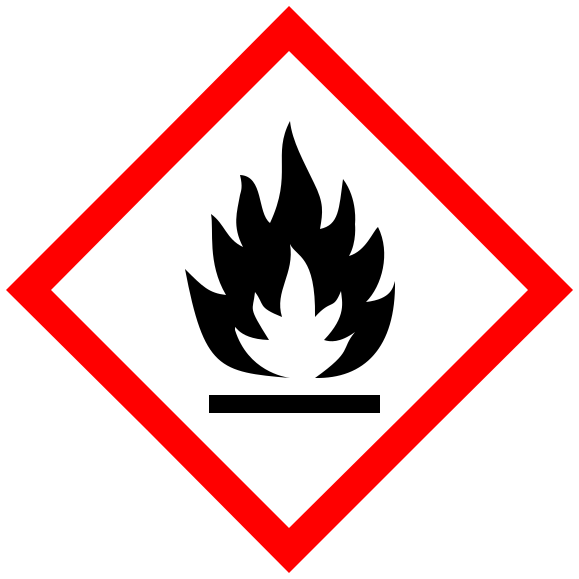
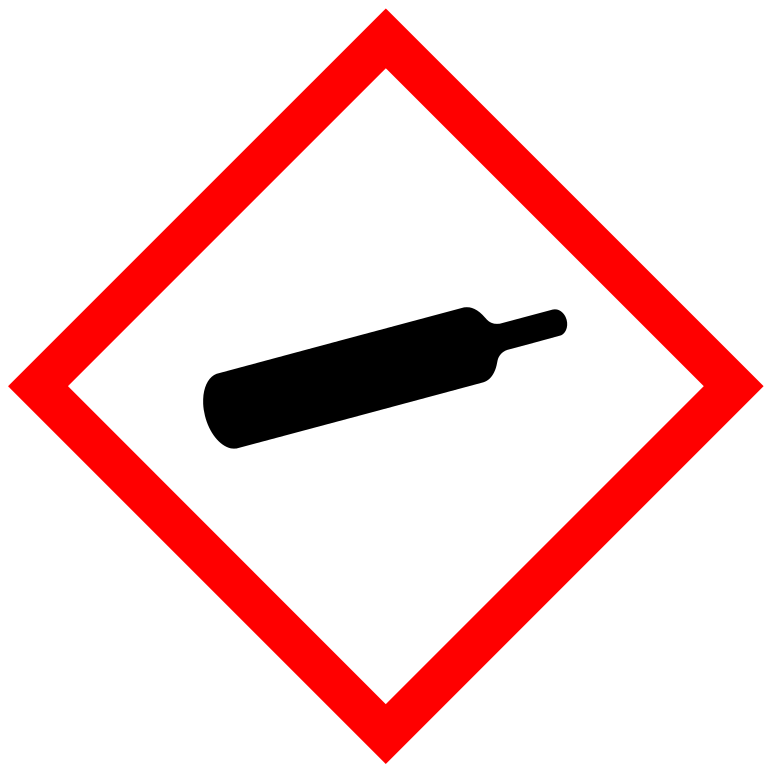
| Hazard class | flammable (simple asphyxiant) |
| GHS signal word | Danger |
| CLP classification | Flammable gases, Category 1; H220 Gases under pressure, liquefied gas; H280 Specific Target Organ Toxicity (single exposure), Category 3; H336 |
| Hazard statements | H220: Extremely flammable gas. H280: Contains gas under pressure; may explode if heated. H336: May cause drowsiness or dizziness. |
| Lower / upper explosion limit | 2.4 vol% / 32.6 vol% |
| Auto-ignition temperature | 440 °C · T2 · group IIB |
| Seveso III named substance | yes |
| EU indicative OELV (8 h TWA) | no EU IOELV |
| EU IOELV short-term (15 min) | — |
| Germany AGW (TRGS 900) | — |
| Netherlands | wettelijke grenswaarde per Arboregeling bijlage XIII — SER grenswaarden database |
| NIOSH REL (USA) | — |
| OSHA PEL (USA) | — |
| IDLH | — |
Simple asphyxiant and mild anaesthetic at high %; the practical hazard is flammability (LEL 2.4 vol%, UEL 32.6 vol%, IIB). Ripening hormone — ppm levels matter for produce storage, not for health.
- NDIR (10.5 µm or 3.3 µm) for ripening rooms (ppm), petrochemical process %-ranges and %LEL safety; catalytic sensors for legacy LEL.
- Alarm 10/20 %LEL; ripening control 10–150 ppm.
| GWP₁₀₀ — IPCC AR6 | — |
| GWP₁₀₀ — IPCC AR4 | — |
| GWP used in Reg. (EU) 2024/573 | not listed |
| Atmospheric lifetime | — |
| Ozone depletion potential | 0 |
| Main IR absorption band (NDIR) | 10.5 µm (ν₇ CH₂ wag, 949 cm⁻¹); 3.2–3.3 µm C–H stretch |
- ATEX / EN 60079-29-1 — %LEL detection
- Post-harvest storage (no OEL of concern)
Tell us what you measure — just tap
Three taps and an email. An engineer replies within 24 h with feasibility and a price indication.
- https://gestis-database.dguv.de/data?name=012710
- https://pubchem.ncbi.nlm.nih.gov/compound/6325
- IPCC AR6 WG1 Ch.7 Supplementary Material, Table 7.SM.7 (https://www.ipcc.ch/report/ar6/wg1/downloads/report/IPCC_AR6_WGI_Chapter07_SM.pdf)
- HITRAN/NIST IR band positions (approximate centre of the strongest band used for NDIR; https://hitran.org, https://webbook.nist.gov)