Identifiers for search
| Name | Methane |
| Formula | CH₄ |
| IUPAC name | methane |
| CAS number | 74-82-8 |
| EC number | 200-812-7 |
| UN number | 1971 — Methane, compressed or Natural gas, compressed, with a high methane content |
| Transport class (ADR/RID) | 2.1 (Flammable Gases) |
| PubChem CID | 297 |
| Synonyms | — |
Physical & chemical properties
| Molar mass | 16.04 g/mol |
| Boiling point (1 atm) | -161.5 °C |
| Melting point | -182.47 °C |
| Critical temperature | -82.6 °C |
| Critical pressure | 45.95 bar |
| Vapour pressure | — |
| Gas density | 0.7175 kg/m³ (0 °C, 1013 mbar) |
| Relative density (air = 1) | 0.56 |
| Solubility in water | 36,7 ml/l at 20 °C |
| Appearance | compressed gas, colourless, odourless |
| Odour | odourless |
| 1 ppm at 20 °C | 0.667 mg/m³ |
Behaviour with temperature and pressure
Boiling point -161.5 °C at 1 atm: a gas at all normal conditions. Critical point -82.6 °C / 45.95 bar: above this temperature it cannot be liquefied by pressure alone — cylinders hold a compressed gas. Relative density 0.56 (air = 1): lighter than air — rises and collects under ceilings; place sensors high. Conversion at 20 °C, 1013 mbar: 1 ppm = 0.667 mg/m³; NDIR reads partial pressure, so readings scale with absolute pressure (value = reading × P/1013) and must be pressure-compensated.
// Extremely flammable gas. Forms hazardous explosive mixtures with air., Only slightly soluble in water., Gas is lighter than air.
Hazards & safety
NFPA 704
health · flammability · instability · special
GHS / CLP pictograms
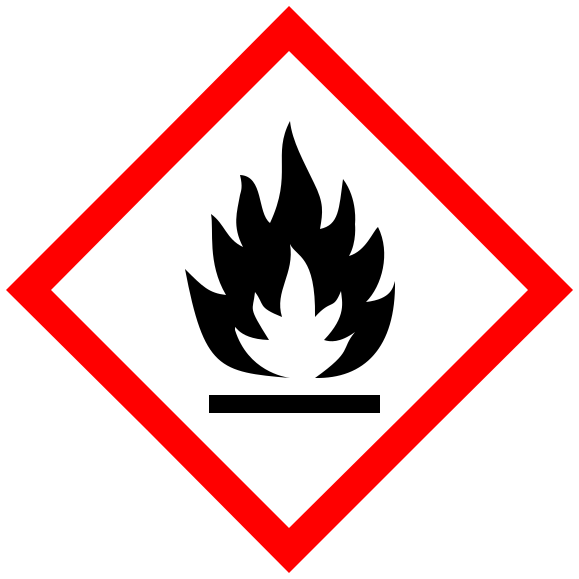
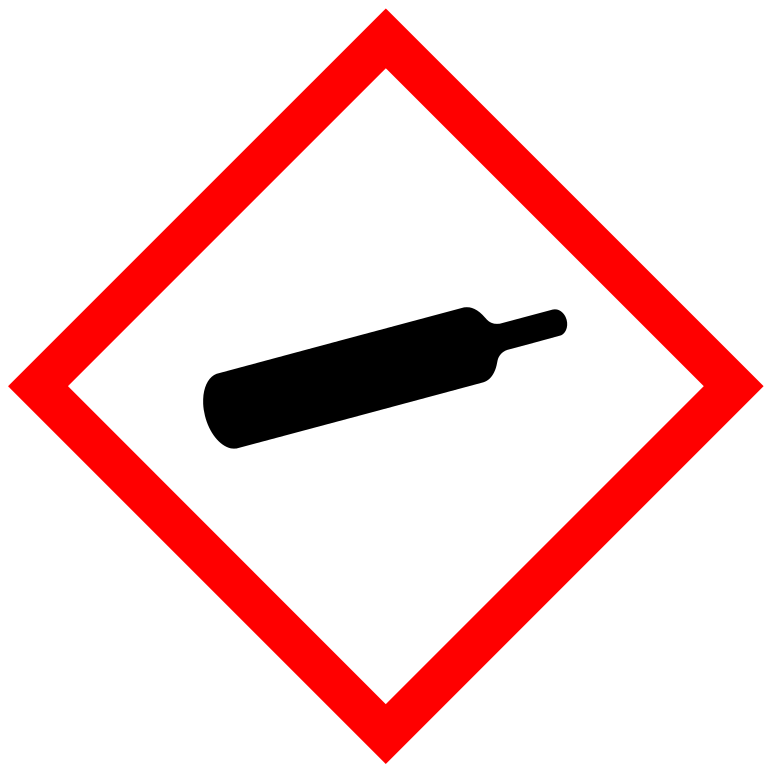
| Hazard class | flammable (simple asphyxiant) |
| GHS signal word | Danger |
| CLP classification | Flammable gases, Category 1; H220 Gases under pressure, compressed gas; H280 |
| Hazard statements | H220: Extremely flammable gas. H280: Contains gas under pressure; may explode if heated. |
| Lower / upper explosion limit | 4.4 vol% / 17 vol% |
| Auto-ignition temperature | 595 °C · T1 · group IIA |
| Seveso III named substance | yes |
Exposure limits
| EU indicative OELV (8 h TWA) | no EU IOELV |
| EU IOELV short-term (15 min) | — |
| Germany AGW (TRGS 900) | — |
| Netherlands | wettelijke grenswaarde per Arboregeling bijlage XIII — SER grenswaarden database |
| NIOSH REL (USA) | — |
| OSHA PEL (USA) | — |
| IDLH | — |
// Limits change: always confirm the current national value before setting an alarm. Values above were read from the EU directives / GESTIS / NIOSH pages listed in Sources.
Effect on people
Simple asphyxiant with no direct toxicity; the hazard is displacement of oxygen and explosion (LEL 4.4 vol%). Odourless — natural gas is odorised artificially.
GESTIS main toxic effects: Acute:
Cold damage/frostbite following contact with refrigerated liquid or expanded gas;
in high concentrations suffocating action due to displacement of oxygen
Chronic:
No substance-related effects known
Recommended monitoring
- NDIR (3.3 µm) is the modern choice for 0–100 %LEL and 0–100 vol%: no O₂ needed, immune to catalyst poisons (silicones, H₂S), fail-safe. Catalytic beads remain for legacy %LEL loops.
- Alarms 10 %LEL (pre) / 20 %LEL (main); sensors at ceiling level (lighter than air). LDAR under Reg. 2024/1787 needs quantification (ppm → %) plus leak localisation.
Climate & atmosphere
| GWP₁₀₀ — IPCC AR6 | 27.9 |
| GWP₁₀₀ — IPCC AR4 | 25 |
| GWP used in Reg. (EU) 2024/573 | 27.9 |
| Atmospheric lifetime | 11.8 years |
| Ozone depletion potential | 0 |
| Main IR absorption band (NDIR) | 3.3 µm (ν₃ C–H stretch, 3019 cm⁻¹); 7.7 µm (ν₄, 1306 cm⁻¹) |
Regulation windows
- Methane Regulation (EU) 2024/1787 — LDAR surveys, MRV; leaks repaired mostly within 5 or 15 working days; importer MRV from 1 Jan 2027
- REPowerEU biomethane — 35 bcm/yr by 2030
- ATEX 2014/34/EU + EN 60079-29-1 for %LEL detectors
Matching Tremon products
Get a quote
Tell us what you measure — just tap
Three taps and an email. An engineer replies within 24 h with feasibility and a price indication.
Other gases
Sources
- https://gestis-database.dguv.de/data?name=010000
- https://pubchem.ncbi.nlm.nih.gov/compound/297
- IPCC AR6 WG1 Ch.7 Supplementary Material, Table 7.SM.7 (https://www.ipcc.ch/report/ar6/wg1/downloads/report/IPCC_AR6_WGI_Chapter07_SM.pdf)
- IPCC AR4 WG1 Ch.2, Table 2.14 (https://www.ipcc.ch/site/assets/uploads/2018/02/ar4-wg1-chapter2-1.pdf)
- Regulation (EU) 2024/573, Annex I/III (https://eur-lex.europa.eu/eli/reg/2024/573/oj)
- HITRAN/NIST IR band positions (approximate centre of the strongest band used for NDIR; https://hitran.org, https://webbook.nist.gov)
// Data compiled 2026-09-17 from the listed primary sources; null values were left blank rather than estimated.